
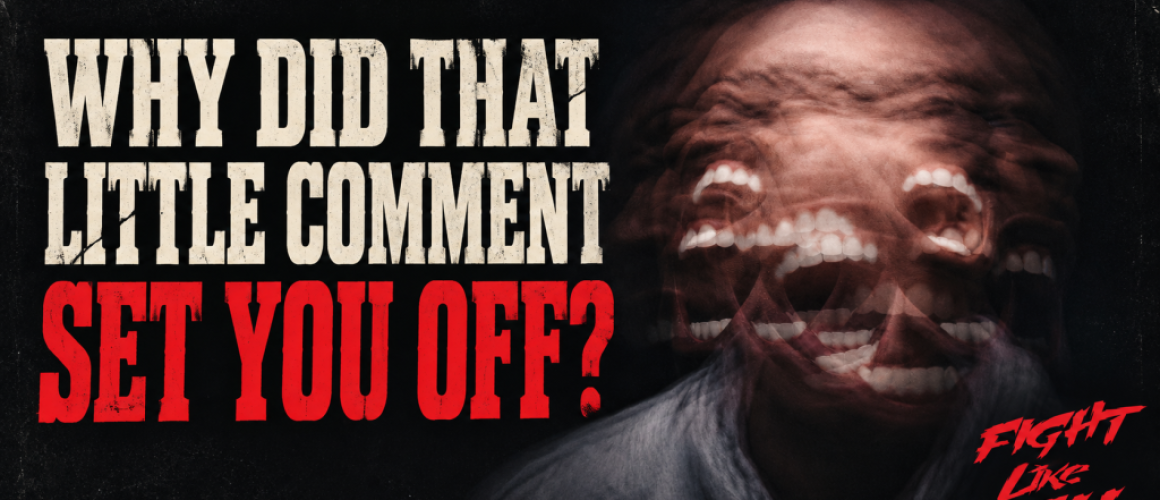
Why Did That Little Comment Set You Off?
Your wife asks if you remembered to make the phone call.
Before she finishes the question, you’re defending everything you’ve done that day. You worked. You ran errands. You handled three other things nobody even noticed.
She asked about a phone call. Somehow, you’re arguing about whether anybody appreciates you.
Later, when the house gets quiet, you replay it. You know you came in too hot. You can still hear your own voice.
What happened between what she said and what you heard?
That’s a question worth taking to a blank page.
Because she might have said, “Did you remember?”
And you might have heard, “You can’t be counted on.”
Those are two very different sentences. Before you can have an honest conversation about what happened, you need to know which one you answered.
Maybe that happens at work. Somebody questions your decision, and you spend the rest of the afternoon building a case against them in your head.
Maybe a buddy makes a joke, and you laugh along. Then you carry it home, turn it over for three hours, and take your frustration out on somebody who wasn’t even there.
Maybe the comment really was cruel. Maybe somebody owes you an apology.
You still have to decide what you’re going to do with the anger.
You can address what somebody said and take responsibility for what came out of your mouth. Both things deserve an honest look.
“I was hurt” can be true.
“I hurt somebody else” can also be true.
Sit with both long enough to learn something.
A lot of us are quick to explain our reactions. We were tired. We had a rough day. They caught us at the wrong time.
All of that might belong in the story. But keep going.
What felt threatened in that moment? Your competence? Your place in the family? Your need to be respected? Were you afraid somebody had noticed something you already criticize yourself for?
Sometimes a question lands on a place that was sore before the conversation started.
Sometimes you’ve been carrying resentment for months, and a forgotten phone call becomes the place you finally unload it.
Sometimes you simply got defensive because you dropped the ball and didn’t want to admit it.
Be willing to find an answer that makes you uncomfortable.
You can spend an entire evening proving that the other person used the wrong tone. You can rehearse the argument until you win every version of it.
You’ll still have to walk back into that relationship tomorrow.
What would help you do that honestly?
Maybe you need to say, “When you asked me that, I felt like you were saying you couldn’t count on me. Is that what you meant?”
Then give them room to answer. You asked a question. Listen to the answer.
Maybe you need to say, “I forgot, and I got embarrassed. I took that out on you. I’m sorry.”
Maybe you need to explain that a joke hurt and ask your friend to leave that subject alone.
There’s courage in being that specific. It means putting down the argument you’ve been rehearsing long enough to let somebody see what actually happened inside you.
That’s deep work. It can feel awkward. You might stumble through it. You might have to come back and try the conversation again.
It’s worth practicing.
The people you love should get a chance to understand you. And you deserve to understand yourself well enough to choose your next words with some care.
Before you defend your reaction again, get curious about it.
Grab a notebook. Think of one recent comment that stayed with you longer than you expected. Write down the words as accurately as you can remember them.
Then finish this prompt.
When they said __________, I heard __________. I felt __________ because I was afraid it meant __________. My response was __________, and what I wish I had said is __________.
Take your time with these questions.
- What did they actually say, and what meaning did I add?
- What do I need to ask them instead of assuming I know?
- What part of my response do I need to own?
- What would an honest follow-up conversation sound like?
You might discover that you misunderstood somebody. You might discover that you’ve been swallowing something you need to address. Either way, now you have somewhere to begin.
For more from Fight Like Hell, spend some time with these posts.
- Fight Like Hell
- Fight Like Hell: A Journal for Men Who Won’t Back Down
- Fight Like Hell: A Call to Action for Men
I created Fight Like Hell: A Journal for Men Who Won’t Back Down to give men a place to do this kind of work. Thirty days of reflections, questions, and room to get honest about what’s happening inside you.
Bring the conversation you keep replaying. Bring the answer you don’t like admitting. Give yourself some time to write it down and decide what comes next.
Get your copy of Fight Like Hell on Amazon.